
A website can be live by Friday and still hold your business back for years. The real question behind custom versus template websites is not whether one looks better on launch day. It is whether the site can support how you sell, serve customers and grow once enquiries, stock, teams and marketing activity increase.
For a Southend tradesperson, a London consultant or an Essex retailer, the right choice depends on what the website must achieve. A template can be a smart route to a polished, credible presence. A custom build can be the stronger commercial investment when your processes, customer journey or eCommerce requirements do not fit inside a standard layout.
Custom versus template websites: the business case
Template websites start with a pre-designed framework. You choose a theme, add your colours, images, copy and pages, then adapt the available settings. They are commonly used for brochure sites, portfolios, landing pages and straightforward online shops. The structure already exists, which reduces design and development time.
A custom website is planned around your business from the ground up. That does not mean every element has to be invented from scratch or that the project becomes unnecessarily complex. It means the architecture, user journey, functionality and visual design are selected to meet defined commercial goals. A custom site might include a tailored quotation process, trade account area, booking journey, product configurator or integration with your CRM, ERP or POS system.
Neither approach is automatically right. The strongest decision comes from matching the platform and build approach to your current needs, budget and next stage of growth.
When a template website is the right move
A template is often the sensible choice when speed and cost certainty matter most. If you are launching a new business, validating a service, building a personal brand or replacing an outdated one-page site, a well-configured template can deliver a major improvement without the cost of bespoke development.
The best template projects are not simply a logo dropped into an off-the-shelf theme. They still require professional decisions around page hierarchy, messaging, mobile layouts, calls to action, image selection, search engine foundations and contact conversion. A visitor should understand what you offer, why they should trust you and what to do next within seconds.
Templates work particularly well where the customer journey is simple. A local service business may need a strong home page, service pages, case studies, reviews, a contact form and clear phone details. A small retailer may need a manageable catalogue, secure payment gateway, delivery information and abandoned-cart recovery. These needs can often be met efficiently with a quality template and properly configured eCommerce tools.
The trade-off is flexibility. Themes are built to suit many types of business, so their options may not reflect your exact process. Trying to force unusual requirements into a template can create cluttered pages, inconsistent design and expensive workarounds. What looked like the cheaper route can become less efficient if you repeatedly pay to patch around limitations.
Where a custom website earns its cost
Custom development becomes valuable when the website needs to do more than present information. If it must reduce manual admin, guide users through a complex purchase, handle customer-specific pricing or connect to core business systems, the build should be shaped around those tasks.
Consider a wholesaler that needs customers to log in, view negotiated prices, place repeat orders and download invoices. Or a training provider that needs course filtering, online bookings, automated confirmations and learner access. These are not just design preferences. They affect staff time, conversion rates, customer confidence and the ability to scale without adding unnecessary operational pressure.
A custom website also gives greater control over the customer journey. Instead of asking visitors to navigate a generic theme menu, you can lead them towards the highest-value action: requesting a survey, booking a consultation, building a quote or completing a purchase. Page layouts, forms and content can be tested and improved around actual behaviour.
Performance is another consideration. Large multipurpose themes often carry scripts, page-builder features and styling that your site never uses. A focused custom build can be leaner, faster and easier to maintain when delivered well. This matters on mobile, where slow pages can cost enquiries before visitors have seen your offer.
Custom does require more discovery at the start. You need clarity on users, workflows, content, integrations and priorities. It also costs more upfront because design and development time are dedicated to your business rather than shared across thousands of theme users. For organisations with a clear long-term plan, that investment can prevent costly rebuilds later.
Compare the costs beyond the launch price
It is tempting to compare a template quote with a custom quote and choose the lower number. A better comparison looks at total value over the next two to three years.
A template can have a lower initial cost, but factor in premium theme licences, plugins, add-ons, developer changes, security updates and future redesign work. Some plugins are excellent; a site dependent on too many can become difficult to manage, particularly if updates conflict or a provider stops maintaining a key feature.
A custom site may cost more initially, yet can reduce recurring manual work and avoid the need for several disconnected tools. If an integration automatically passes online orders into your fulfilment process, or a tailored form qualifies enquiries before they reach your sales team, the return can be measured in time as well as revenue.
Hosting, security and support should also be part of the decision. A website is not finished when it goes live. It needs monitored hosting, backups, software updates, security protection and a clear support route when something changes. Whether the site is template-based or custom-built, these are business continuity essentials rather than optional extras.
Design quality is not decided by the starting point
A template can look premium. A custom website can look poor. The difference is usually in strategy and execution, not the label attached to the build.
Good design makes the business easy to understand and easy to trust. It uses consistent branding, clear navigation, purposeful imagery, readable copy and prominent calls to action. It also respects accessibility and responsive behaviour, so customers can use the site confidently from a phone, tablet or desktop.
Custom design is most useful when your brand needs to stand apart in a crowded market or when standard layouts cannot communicate your value properly. For example, a high-end construction firm may need project storytelling and visual proof of quality, while a specialist manufacturer may need technical content organised around sectors, specifications and enquiries.
For many small businesses, a refined template with tailored branding is more than enough. The priority is to avoid a generic result. Stock wording, vague service pages and copied competitor layouts will weaken either type of site.
Questions to ask before choosing
Before committing, be honest about what must happen after a customer lands on the website. Do they simply need to call or enquire, or do they need to book, configure, purchase, log in or manage an account? Will your product range, team or marketing activity grow significantly within the next year? Do you need integrations with existing systems? And who will be responsible for updates once the site is live?
If your requirements are clear and straightforward, a professionally delivered template site can get you to market quickly and provide a strong platform for local visibility. If the website must support distinctive workflows, heavy eCommerce, automation or a differentiated customer experience, custom development is likely to provide better long-term value.
There is also a middle ground. Many businesses begin with a focused, conversion-led site and add capability in planned phases. This protects cash flow while ensuring the first build has a sensible structure for future expansion. The key is not to buy features you will never use, but not to choose a platform that blocks the features your business genuinely needs.
Build for the next customer, not just the launch date
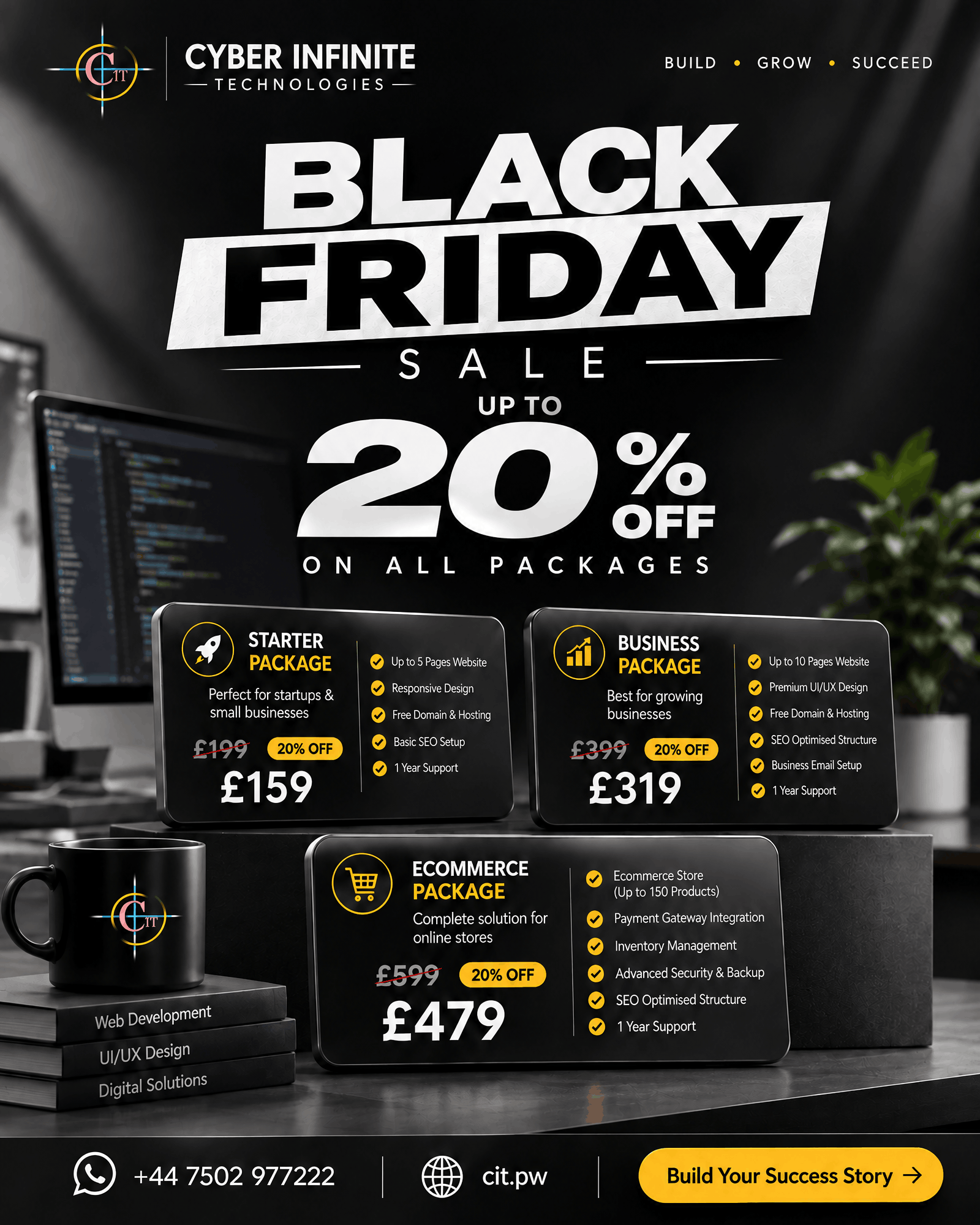
Cyber Infinite Technologies helps UK businesses assess the commercial purpose behind a website before recommending the most suitable route. That can mean an accessible package built for fast credibility, or a more advanced platform with eCommerce, cloud hosting, security, SEO foundations and business integrations designed into the project.
Choose the option that makes it easier for customers to trust you, contact you and buy from you – then make sure it has the support, security and room to keep working as your business moves forward.